by Alena Uliasz, Community Development Graduate Group, and Vanessa Terán, Mixteco/Indígena Community Organizing Project (MICOP)
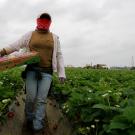
In California, home to the largest population of immigrant farmworkers in the nation, a third of farmworkers are members of Indigenous communities from Southern Mexico. Many speak only an Indigenous language like Mixteco, Zapoteco, or Triqui, and research suggests they are denied access to trained interpreters and face discrimination.
by Erin Hamilton, Jo Mhairi Hale, and Robin Savinar
Although we might think that legal vulnerability would lead to poorer physical health, a new study finds that unauthorized farm workers reported better physical health than legal permanent residents and naturalized citizens.
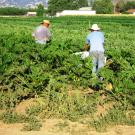
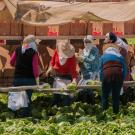
Many of us are familiar with the story of Cesar Chavez and how he and other farmworkers organized themselves to fight for farmworker rights. Although much progress has been made, many farmworkers continue to work long hours in unsafe conditions and with low pay.
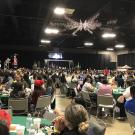
The Annual Promotores Conference is always free, conducted in Spanish, and open to anyone interested in learning about community issues such as labor rights, child development, health and wellbeing, domestic violence, and more.
New research is taking place at WCAHS, thanks to its Small Grant Program, which provides funds to graduate students and faculty members from around the region to carry out projects related to agricultural health and safety.
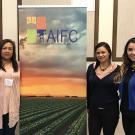
On September 26th - 28th, the WCAHS Outreach Team attended the 22nd Annual Arizona Interagency Farmworkers Coalition (AIFC) Conference held in Yuma, Arizona.
Two vacant WCAHS administration positions were filled this fall with Fadi Fathallah, PhD, becoming the new WCAHS Associate Director and Christopher Simmons, PhD, becoming the new WCAHS Director of Research.
The WCAHS Outreach & Education team traveled to Morelia, Mexico, this past August to present their recent work on addressing sexual harassment in the agricultural workplace.
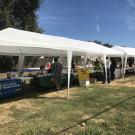
This is the second year that WCAHS has participated in a community health fair organized by the student volunteers at the Knights Landing One Health Center, a UC Davis student-run clinic that provides valuable primary health care services to the Knights Landing community every first and third Sunday of each month.
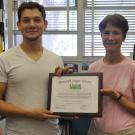
The California Heat Illness Prevention Study (CHIPS) received a research paper award at the June 2017 International Society for Agricultural Safety and Health conference held in Logan, Utah.